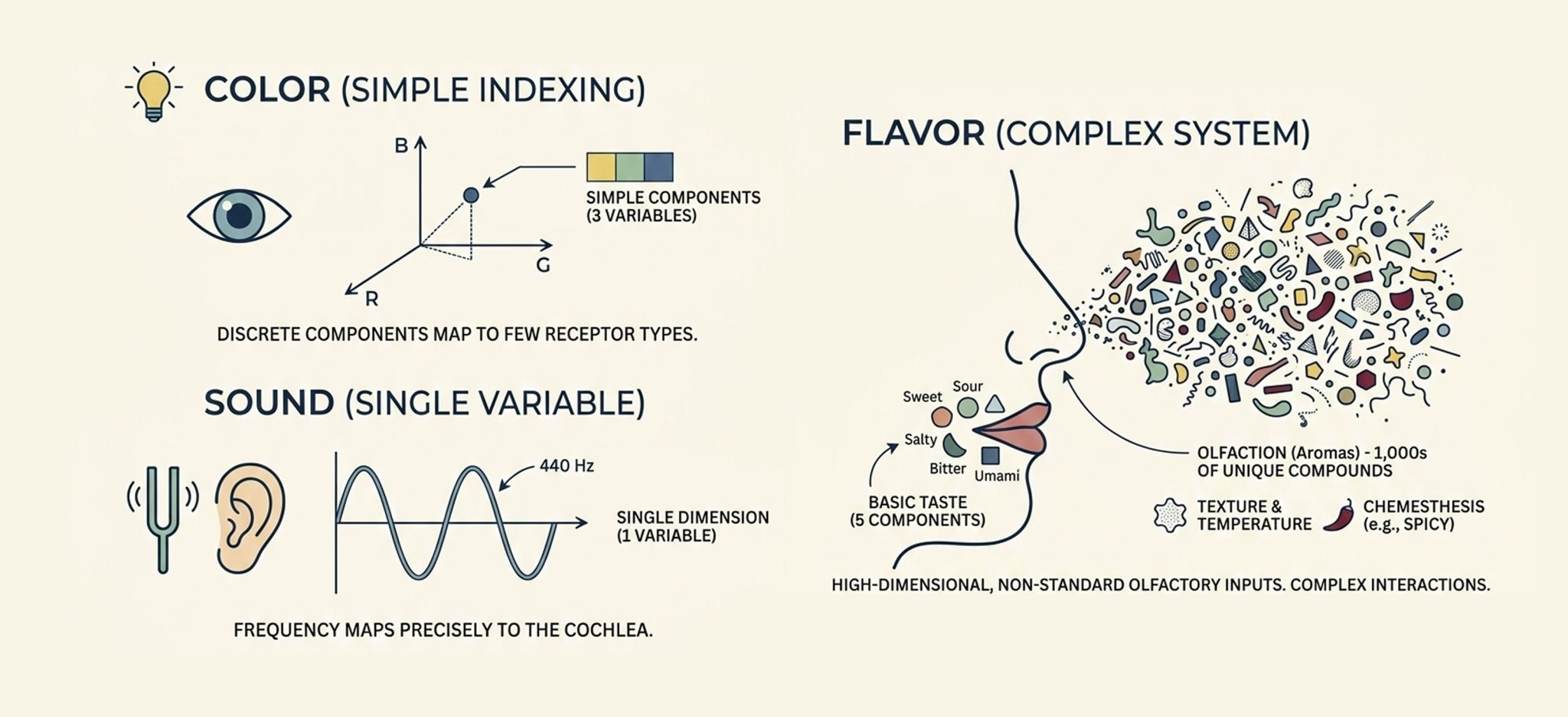
Human vision relies on 3 types of cone photoreceptors. All respond to the same physical property: wavelength of light. Trichromacy means any perceivable color can be reproduced by mixing three primaries. The mapping from stimulus to percept is linear, additive, and universal across nearly all observers.
Auditory pitch maps to a single physical dimension: frequency of air pressure waves. One stimulus property. One perceptual axis.
Now #taste.
You have ~25 #bitter receptor genes alone, each encoding multiple receptor variants. The TAS2R38 gene creates a 100 to 1,000-fold sensitivity gap between tasters and non-tasters (Kim et al., 2003, Science). One person’s “intensely bitter” is another person’s “tasteless.” Same #molecule.
Then #smell, which drives most of what we call #flavor. ~400 receptor classes responding to ~5,000 chemical parameters. Non-linear. Non-additive.
Structurally different molecules can smell identical. Identical molecules can smell opposite depending on your receptor gene #repertoire (Doty, 2025, Chemical Senses).
But the deepest problem is not #biological. It is #cognitive.
Linda Bartoshuk showed that when a supertaster and a non-taster both rate a stimulus “7 out of 9,” they are describing completely different experiences. The scale itself cannot capture the difference. She called it the El Greco Fallacy: a painter with astigmatism stretches his figures but sees them as normal, because he views the world and the canvas through the same distorted lens (Bartoshuk et al., 2002).
Paul Rozin spent decades showing that food preference is not a sensory readout. It is a cognitive construction shaped by #learning, #memory, #culture, and #identity. Different experience. Not because of different #tongues. Because of different #minds (Rozin et al., 1999).
Color has a universal coordinate system because 3 receptor types map to 1 physical dimension.
Taste has none because hundreds of receptor types map to thousands of chemical dimensions, filtered through personal #biology, processed through learned #cognition, and expressed through culturally-bound #language.
The question is not how to #standardize taste. It is how to model the variation back to its high dimensional nature.