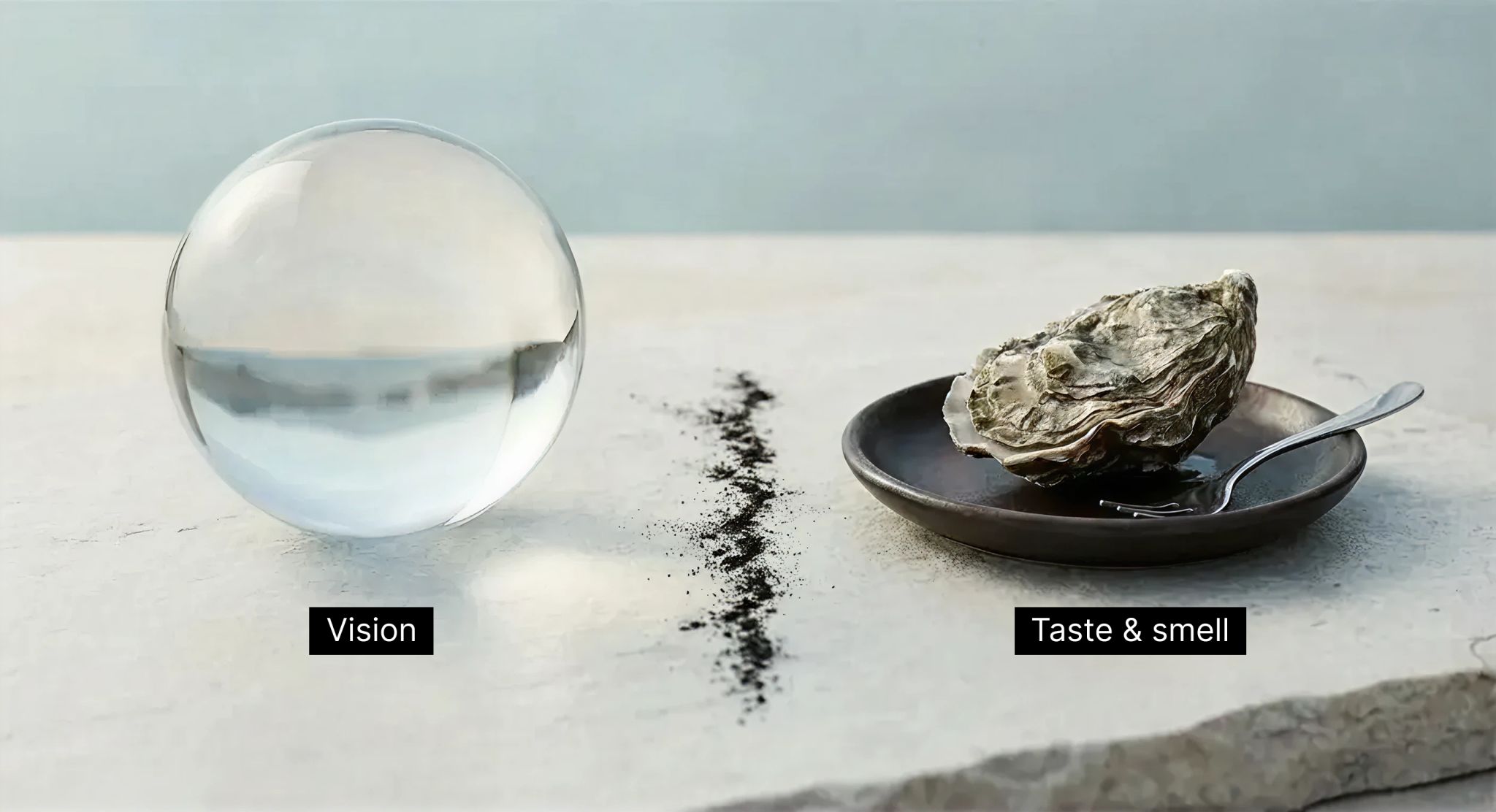
Vision keeps you safe. You can look at anything and choose to pay attention or not. Taste demands your attention every time, it lets the #world in. In the past, this was about #survival. Today, it is a reflection of #self-state.
Carolyn Korsmeyer calls taste the "intimate sense." It is the only sense where the object is #destroyed in the act of #knowing it. You cannot taste and remain unchanged. The object becomes part of you, or you reject it. There is no neutral position. Every taste is a #decision with #consequences.
For most of human history, the tongue was the last safety checkpoint between the world and the body. Today survival is rarely at stake but the mechanism remains. You can scroll through a hundred photos of durian and form no opinion. But one bite forces a #verdict. Durian does not accept #spectators.
The same to your first raw oyster, fermented shrimp paste, stinky tofu, bitter melon soup. Nobody learns to hate or love these through just looking. You had to #engage. You had to "risk".
For 2,500 years, Western philosophy classified taste and smell as "lower bodily senses." Plato started it, Kant reinforced it, and the food industry inherited it. But contemporary aesthetics is pushing back: Taste carries more than we have ever acknowledged, communicated, or crafted, and it remains largely underexplored.
So if taste is where we let the world in, it might be worth asking: what are we actually inviting people to commit to?