
Platform Capabilities
TasteNET is a B2B consumer simulation platform built on multi-agent consumer digital twins. Food and beverage teams use it to validate consumer acceptance of new products before production. Two products, Twin Chat and the Simulator, run on one base of twins.
See which consumers will choose your product, in 38 countries and regions.
Compare concepts, recipes, packs and prices on the same twins before launch.
Pre-test claims and channels, and see how word of mouth spreads.
Every finding links back to the twins who said it, with a confidence level.
Architecture
Five layers, from real-time data up to the interface your team works in.
See real-time digital twin simulation, with a traceable decision-making flow and its drivers.
Reconstructs each twin's episodic flavour memory from the queried stimulus.
Re-weights responses with region-level psychophysical and socio-dynamic rules.
Multimodal embeddings with GNN and BNN, feeding a statistical, relation-based prediction model.
Time-windowed qualitative and quantitative interviewee inputs feed into the digital twins.
Twin Chat: Interview AI Consumer Digital Twins in Real Time
Twin Chat is the interview product inside TasteNET. Food and beverage teams chat with 100 to 1,000 AI consumer digital twins, one at a time or as a group, to see who likes a product, who hesitates and why.
Filter twins by taste type, foodie personality, market, age and gender, then pick who joins the room and which product they discuss. One twin or a hundred at once.
Put one question to the whole room and every twin answers in its own words and its own language. Address a single twin with @ to follow up.
One click turns the room into a synthesis: the verdict, how the answers split, and the reasons behind each side.
What Is Twin Chat?
Twin Chat lets you interview AI consumer digital twins directly. Click into any twin to see exactly why they responded the way they did.
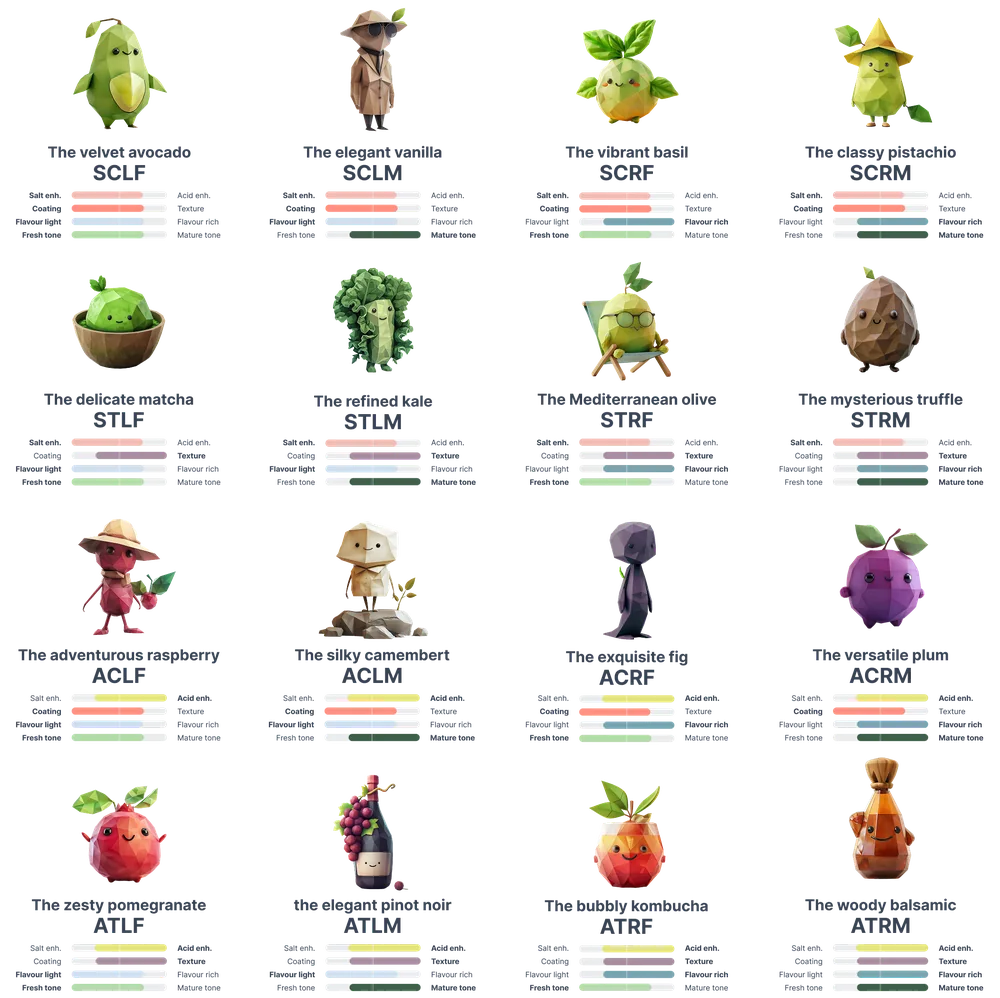
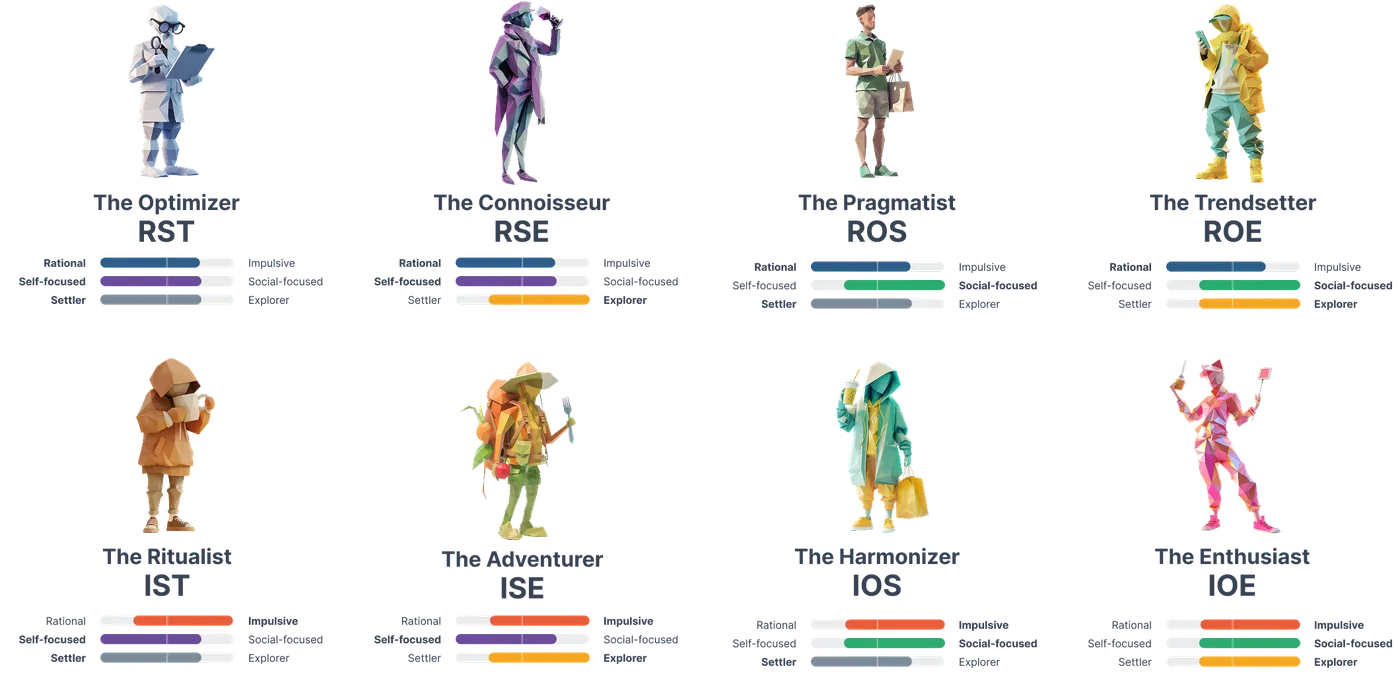
Filter twins by 16 Taste Types, Foodie Personalities, market, age, gender, household and diet.
Each twin also carries demographic tags: market, age, gender, household and diet.
16 Taste Types sorts a person's sensory preference on four axes: salt or acid, coating or texture, light or rich flavour, fresh or mature tone.
Foodie Personalities sorts how a person chooses food on three axes: rational or impulsive, self-focused or social-focused, settler or explorer.
What You Can Ask
Ask open questions to find out what matters to these consumers before you decide what to measure.
Ask who, how many and how much: who likes the product, who hesitates, and how strongly.
Ask what would change the answer: a lower price, a different claim, less sugar.
- Fishy34%
- Savoury, not sweet24%
- A novelty19%
- Fine dining14%
- Other9%
- Cola
- Fruit soda
- Sparkling water
1st2nd3rd
- Cold rush in the nose32%
- Tingle on the tongue26%
- Fresh breath21%
- Close to a sting13%
- Barely there8%
- Salmon mousse46%
- Salmon ice cream29%
- Neither25%
Classic 58%30% less sugar 42%
Mean 6.1
'Salmon ice cream' 3.9'Salmon mousse' 5.2+1.3
- Same price42%
- ¥2 more27%
−15 points
Unlabelled 5.6'90% menthol' 6.7+1.1
The Simulator: Run the Launch Before You Launch
The Simulator is the launch forecasting product inside TasteNET. Food and beverage teams run a launch on 50 to 1,000 AI consumer digital twins and see acceptance from first exposure to word of mouth, before production.
Twins walk the aisles, compare the shelf, pick a product up or put it back, and queue at the till. See where a launch gets noticed and where it gets passed by.
Twins order, taste and react dish by dish, in their own words. See which plates win the table and what diners say about flavour, portion and price.
Twins pass a launch along their social ties, wave by wave. Each one moves from first exposure to purchase, experience and advocacy, and the trail of word of mouth stays visible.
What Is the TasteNET Simulator?
The TasteNET Simulator is a market behaviour simulator built on real-world taste preferences and psychological decision models.
Upload your product details: ingredients, flavour profile, positioning and go-to-market information. Select a target market and cohort, then run the simulation.
From First Exposure to Word of Mouth
Each twin evaluates your product across the four-stage EPXA acceptance funnel. Pick a channel to see where people drop out.
Supermarkets and convenience stores, where a pack has seconds on a crowded shelf to win attention.
Marketplaces and brand stores, where search, listings, ratings and price comparison decide the basket.
Restaurants and chains, where people taste the dish first and judge the brand after.
Grab-and-go counters, kiosks and vending, where the purchase is quick and loyalty is fragile.
- Claim resonance
- Pack design
- Shelf standout
- CEP fit
- Price sensitivity
- Intent formation
- Comparison
- Impulse
- Sensory evaluation
- Satisfaction
- Expectation gap
- Sharing
- Repurchase
- Brand loyalty
- Recommendation
What the Report Contains
The report follows every twin through four moments, finds where the most people drop out, and turns each leak into an action for localisation, reformulation, claims or portfolio.
Do they notice it, and does the claim fit a moment they care about?
Do they choose it over the alternatives, at this price, on this shelf?
Does the first taste deliver what the pack promised?
Do they buy again and tell others?
You receive a full acceptance report with segment-level diagnostics in under 30 minutes.
- Claim resonance
- Shelf standout
- CEP fit
ClaimsLead with the morning moment on the front of pack.
- Price vs benchmark
- Comparison with leader
- Impulse appeal
PortfolioAdd a smaller pack at a lower entry price.
- Sensory liking
- Expectation gap
- Aftertaste
ReformulationKeep the recipe and soften the aftertaste.
- Repurchase intent
- Sharing
- Brand loyalty
LocalisationAdd a regional flavour that gives people something to talk about.
Frequently Asked Questions
What is the difference between Twin Chat and the Simulator?
Twin Chat and the Simulator are the two products inside TasteNET. Twin Chat is the interview product: teams chat with 100 to 1,000 AI consumer digital twins to see who likes a product, who hesitates and why. The Simulator is the launch forecasting product: it runs a launch on 50 to 1,000 twins, from first exposure to word of mouth. Both run on one base of twins.
Can I A/B test recipes, packs and prices in TasteNET?
Yes. TasteNET compares concepts, recipes, packs and prices on the same twins before launch, so both options face the same consumers. Typical tests set a classic recipe against a reduced-sugar version, one product name against another, or the same product at two price points.
Does TasteNET report standard research metrics such as Top-2-box?
Yes. TasteNET reports purchase intent on a five-point scale with Top-2-box, Top box, Bottom-2-box and net score. Twin Chat also returns 1-to-9 liking and willingness scores, rank order, choice share and open answers grouped by theme, each for the market and segment selected.
Can TasteNET pre-test claims, product names and campaigns?
Yes. TasteNET pre-tests claims and channels and shows how word of mouth spreads. In Twin Chat, causal questions change one thing at a time, such as the product name, a label claim or the price, and measure how the answer moves. In the Simulator, the Exposure stage scores claim resonance, pack design and shelf standout.
Can I trace a TasteNET result back to individual consumers?
Yes. Every finding in TasteNET links back to the twins who said it, with a confidence level. In Twin Chat, clicking into any twin shows why it responded the way it did, and the interface shows the decision-making flow and its drivers.
Can TasteNET predict product acceptance in different countries and cities?
Yes. TasteNET maintains a Sensory Map with region-specific flavour rules, intensity thresholds, and taste baselines for 118 regions across 38 countries. Each region's profile includes primary flavour rules (for example, Plateau Umami Cumin Heat for Qinghai, China), flavour keywords, and dynamic sensory trends updated from multi-source market signals. When you run a simulation, twins respond within the sensory and cultural context of their region. So the same product may score 85% acceptance in Singapore and 62% in Mexico City, with clear reasons tied to the sensory baseline differences.
What kinds of questions can I ask in Twin Chat?
Twin Chat takes three kinds of question. Exploratory questions are open and find out what matters to consumers before you decide what to measure. Descriptive questions ask who, how many and how much. Causal questions ask what would change the answer: a lower price, a different claim or less sugar.
How many AI consumers can I interview in Twin Chat?
Twin Chat interviews 100 to 1,000 AI consumer digital twins at a time, one by one or as a group. The Basic plan gives access to up to 1,000 public-pool twins and the Panoramic plan to up to 5,000.
How do I choose which twins to interview?
Twin Chat filters twins by market, age, gender, household and diet, and by two Digitaste frameworks. 16 Taste Types sorts sensory preference on four axes: salt or acid, coating or texture, light or rich flavour, fresh or mature tone. Foodie Personalities sorts food choice on three axes: rational or impulsive, self-focused or social-focused, settler or explorer.
Can Twin Chat test a flavour concept before a prototype exists?
Yes. Twin Chat works from a description, so a concept can be tested before a sample exists. Teams ask how consumers picture a flavour, what a sensory word means to them and which version they would try, for example what "strong enough" cooling feels like in a mint. Twins answer from their measured preferences and do not physically taste.
How is Twin Chat different from a focus group or an online survey?
Twin Chat combines the depth of a focus group with the scale of a survey. Teams ask open follow-up questions, as in a focus group, of up to 1,000 twins at once, as in a survey. Answers arrive in real time, and each one traces back to an individual twin. Finalists are then confirmed with a smaller human panel.
What is the TasteNET Simulator and how does it work?
The TasteNET Simulator is the launch forecasting product inside TasteNET. You upload your product details (ingredients, flavour profile, positioning, and GTM information), select a target market and cohort, and run a simulation against anywhere from 50 AI consumer digital twins for a quick directional check to 1,000 for a full market simulation. Each twin evaluates your product across the 4-stage EPXA acceptance funnel: Exposure, Purchase, Experience, and Advocacy. You receive a full acceptance report with segment-level diagnostics in under 30 minutes.
What do I need to provide to run a TasteNET simulation?
A TasteNET simulation needs your product details and a target. Upload the ingredients, flavour profile, positioning and go-to-market information, then select a target market and cohort. The simulation runs from this description, so no physical samples are needed.
How long does a TasteNET simulation take?
A TasteNET simulation returns a full acceptance report with segment-level diagnostics in under 30 minutes. It runs on 50 twins for a quick directional check or on up to 1,000 twins for a full market simulation.
What is the EPXA acceptance funnel?
EPXA is the four-stage acceptance funnel every TasteNET twin passes through: Exposure, Purchase, Experience and Advocacy. Exposure asks whether consumers notice the product. Purchase asks whether they choose it at this price. Experience asks whether the first taste delivers what the pack promised. Advocacy asks whether they buy again and tell others.
What does the Simulator report contain?
The Simulator report follows every twin through the four EPXA stages and shows where the most people drop out. It turns each leak into an action for localisation, reformulation, claims or portfolio, with segment-level diagnostics. For example, a leak at Purchase can point to a smaller pack at a lower entry price.
Which sales channels can the Simulator model?
The Simulator models four channels: retail (supermarkets and convenience stores), e-commerce (marketplaces and brand stores), foodservice (restaurants and chains) and on-the-go (grab-and-go counters, kiosks and vending). Pick a channel to see where consumers drop out of the funnel in that setting.
Can TasteNET predict how a recipe will be liked without a physical tasting?
Yes, as a prediction. Twins do not physically taste. The Simulator sets your ingredients and flavour profile against each twin's measured preferences for aroma, taste and mouthfeel, and reports sensory liking, expectation gap and aftertaste at the Experience stage. Teams then confirm the finalists with a smaller human panel.
Can the Simulator forecast word of mouth?
Yes. The Advocacy stage of the Simulator models sharing, recommendation, repurchase and brand loyalty. In the particle view, each dot is one twin, and the lines between dots show word of mouth spreading from one consumer to the next in waves.
How does TasteNET help with product reformulation?
First, we diagnose whether it is a formulation problem or a consumer expectation problem. Most of the time the formulation itself is not what went wrong; the context is. When it is about the formulation, TasteNET runs it against each AI consumer's sensory parameters (sweetness and saltiness intensity, texture, and flavour balance) and shows exactly how each change shifts acceptance across segments: which cohorts tolerate a 20% sugar reduction without noticing, and which perceive it as a downgrade.