Flavours That Feel: How Affective Sensory State Drives Our Food Choice
. By Digitaste
Essay
You’ve had a long day at work: back-to-back meetings, emails piling up, your shoulders tight with stress. On the way home, you’re not thinking about calorie counts or your nutrition plan. You just want that rich, savoury beef stew and a sweet chocolate brownie to soften your mood with warmth. That’s the comfort you’re seeking, the kind that brings a sense of safety and belonging.
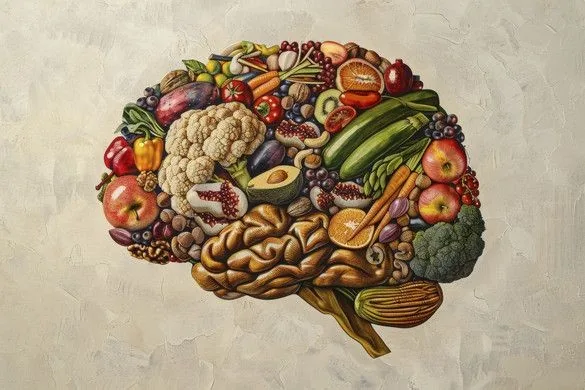
Taste is not just taste, it’s emotional modulation in motion. A growing body of research in affective neuroscience and sensory psychology shows that taste perception is tightly coupled with emotional states, reflecting our day to day experiences.
In a study published in Appetite, Macht and Mueller (2007) found that individuals experiencing negative emotions not only reported stronger cravings for sweet and fatty foods but also rated those foods as more pleasant when consumed in a negative mood, suggesting that taste serves a mood-regulatory function.
Further, emotional states can modulate taste sensitivity itself: a 2021 study in Scientific Reports by Kori et al. showed that participants in sad or stressed conditions experienced reduced sensitivity to sour and bitter tastes, while sweet perception remained stable or slightly enhanced, possibly explaining the comfort appeal of sweetness.
On the neural level, research from Kringelbach et al. (2004, NeuroReport) identified the orbitofrontal cortex as a key site where emotional value and sensory input from food converge, encoding not just what we taste, but how it feels to us in the moment.
In a nutshell, flavour brings you more than just sensation or nutrition; it brings you that feeling. And often, it’s our emotional state, not hunger, that’s deciding what we reach for the next.
Just like we choose different words to express ourselves depending on our mood, our cravings speak their own language: flavour becomes a kind of emotional vocabulary.
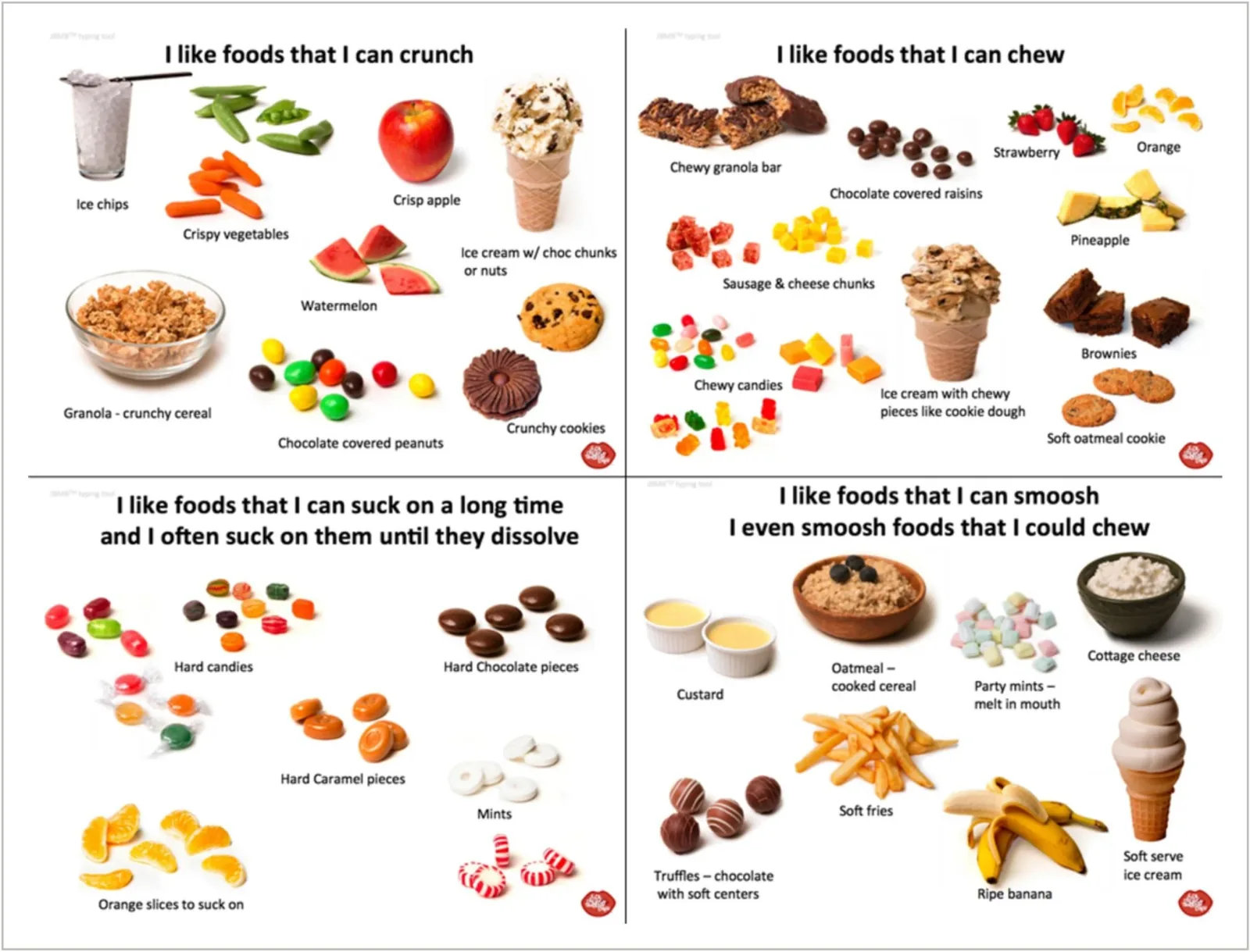
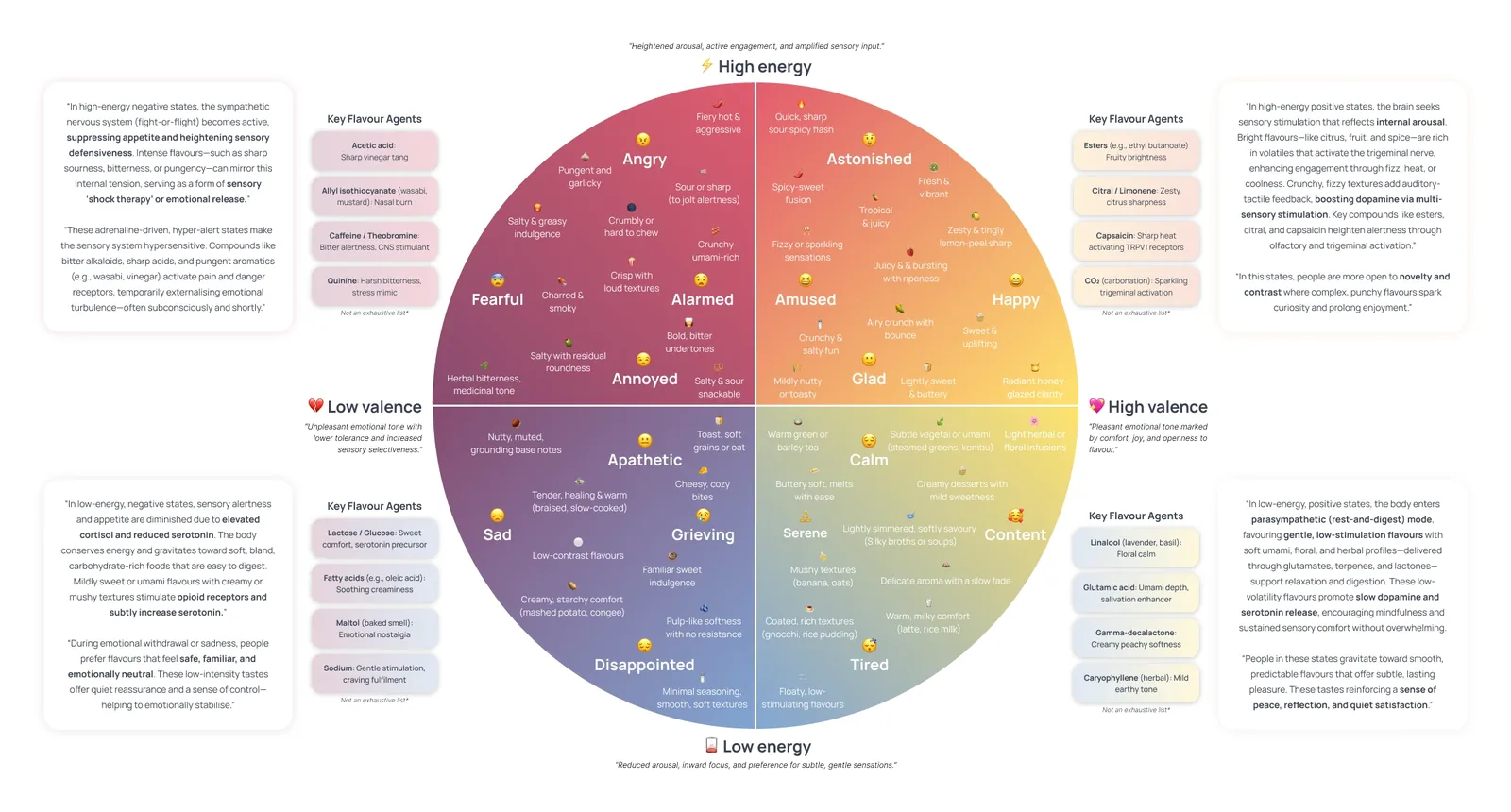
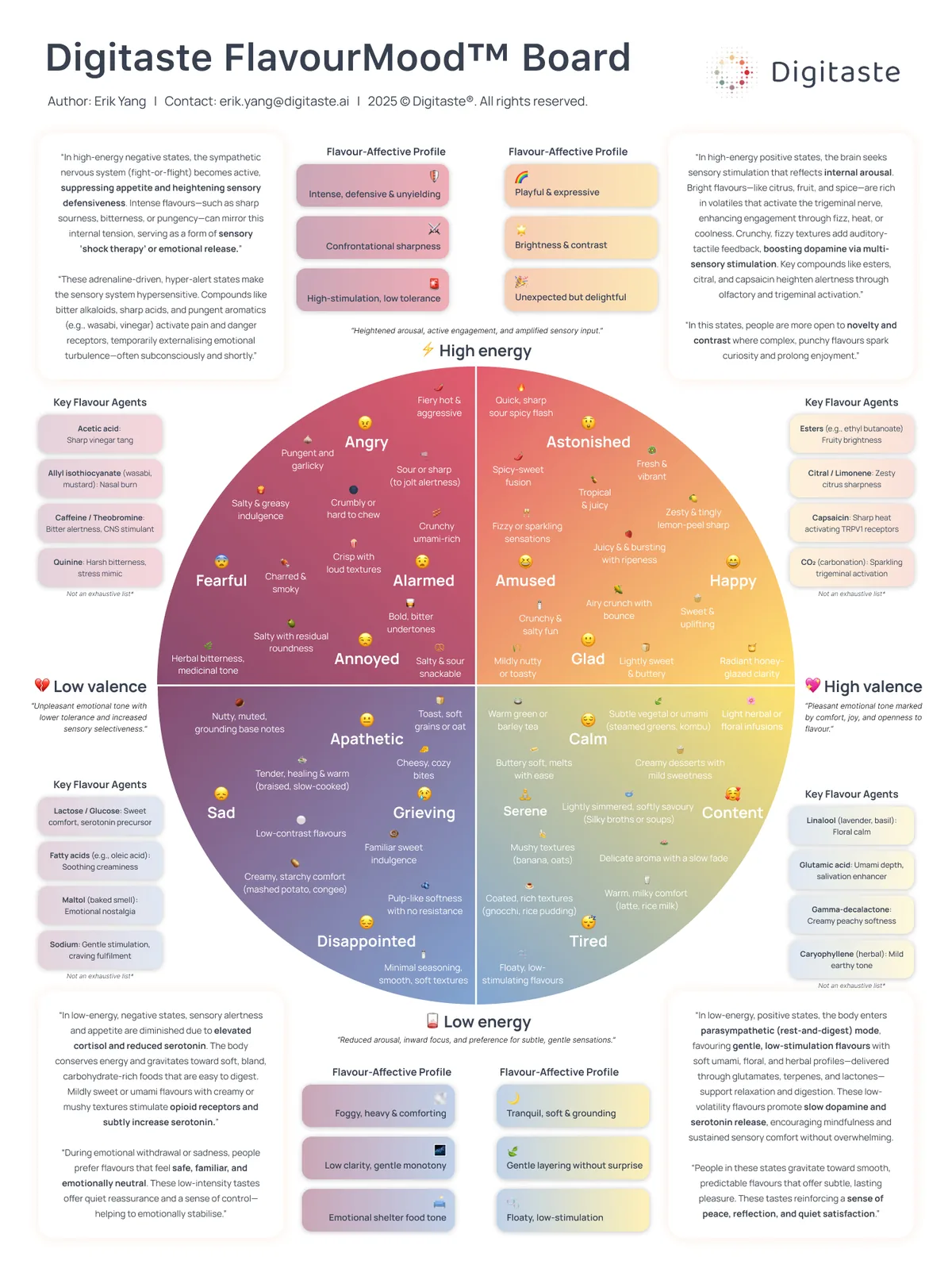
Studies show that individuals in states of joy or excitement are more likely to seek high-arousal, bright-tasting foods, such as sour candies, citrusy drinks, or crunchy textures, flavours that mirror their elevated internal state (Desmet & Schifferstein, 2008, Food Quality and Preference).
In contrast, when feeling emotionally depleted or sad, people gravitate toward low-arousal comfort flavors: warm, creamy, sweet, or starchy foods, like mashed potatoes, chocolate, or breaded dishes, which offer both physiological calm and psychological security (Spence, 2017).
This behaviour isn’t random: research in affective forecasting and food psychology suggests that people often use food to maintain or regulate affective congruence, seeking flavours that either match or mend their internal state (King et al., 2013, Appetite).
The result is an emotional “flavour grammar” we all speak instinctively: sour can uplift, bitter may ground, sweet can soothe, and spicy might help us release. Without realising it, we reach for what resonates.
When Mood Shapes Motivation: Why We Choose Certain Flavours
Our emotional state doesn’t just influence flavour perception; it actively drives our food choices, often without conscious awareness. Research in affect regulation shows that individuals are motivated to seek out specific sensory experiences to either maintain a current mood or change it (Macht, 2008, Appetite). This creates two primary emotional eating patterns:
Mood-congruent eating: When we’re happy, we seek playful, energising flavours: tangy, fizzy, or refreshing tastes that match our elevated state.
Mood-regulating eating: When we’re stressed, anxious, or low, we turn to emotionally compensatory foods: creamy, warm, or savoury comforts that help restore emotional balance.
In a 2018 study published in Appetite, van Dillen et al. demonstrated that participants experiencing cognitive fatigue or negative emotions showed significantly increased preference for high-calorie, high-palatability foods, not due to hunger, but as a motivated emotional coping strategy. Similarly, researchers at Wageningen University found that sadness increased desire for sweet and starchy foods that are emotionally learned as safe or comforting through past associations (Evers et al., 2010).
This means when you reach for a bowl of ice cream after a breakup or crave a citrusy soda after finishing a big project, it’s not just about flavour; it’s your nervous system reaching for emotional homeostasis, using food as a sensory regulator.
Designing for Sensory-Affective Moments
If mood shapes flavour desire, then food and beverage experiences can, and should, be designed to meet people where they feel. This is the emerging frontier of sensory-affective design: crafting menus, products, and environments that align with specific emotional states.
Researchers in sensory marketing (Krishna, 2012) have long shown that congruent sensory cues (colour, texture, sound and taste) can enhance emotional satisfaction and even perceived flavour intensity. In hospitality and retail settings, this has sparked trends like “mood-based menus” or emotion-driven pairing systems (Spence et al., 2014, Flavour Journal), where dishes are curated not by region or price, but by how the diner wants to feel: uplifted, soothed, stimulated, or comforted.
Brands are beginning to catch on. Functional drinks that promote “calm” now feature subtle florals and soft carbonation, while energy snacks for productivity lean into bright citrus, chili, and crunch. Even fine dining is exploring this dimension: chefs design tasting courses to move guests through an emotional arc, pairing flavour intensity and mouthfeel with lighting, tempo, and tone.
The future of flavour is not just about ingredients; it’s about emotional context. By understanding how mood and flavour interact, creators can build products and experiences that don’t just nourish the body, but also serve the moment the eater is living in.
Feeling Is the New Flavour
We’ve long approached taste as a matter of palate, preference, or culture, but what if flavour is also a mirror for our inner world? If each bite carries not just a chemical signature but an emotional one, then flavour becomes a language of the self, spoken through sensation. Emerging research in neurogastronomy and affective computing is already pointing us in this direction: flavour choices can reflect psychological needs, and flavour design can, in turn, support emotional well-being (Spence, 2017; Shepherd, 2012).
This redefines what it means to create, serve, and even consume food. Whether you’re a chef, product developer, UX designer, or simply someone who eats with feeling, you’re already engaging in emotional design through taste.
So the question isn’t just “What do people want to eat?”
It’s “How do they want to feel, and how can flavour help get them there?”
Related
Another essay, and the science behind it.