NextGen Sensory
Intelligence
Measurable taste, Predictive acceptance, Launch with confidence
The world model is learning to taste. We are building the human-centric taste and smell layer of AI, linking real human sensory experience to machine to understand and helping to produce more nutritious and tasty food in the future.
01
Real-World Digital Twins

Each digital twin is a fully constructed consumer identity, built from real first-party sensory profiling, food choice behavioural data, and a 40-minute qualitative food memory interview. Every twin carries a complete profile around all food decisions. When a twin responds to your product, you can inspect exactly why, clicking through to their individual decision drivers, hesitations, and sensory reactions. No black box. No averaged personas. A real consumer, reconstructed.
Use Cases
A functional beverage brand tests whether "zero sugar, real fruit enzymes" lands as a health claim or a compromise signal across 1,000 twins before committing to packaging copy.
A premium matcha oat milk brand discovers that price resistance at $6.50 per bottle is concentrated in Pragmatist segments, not Adventurers, and adjusts channel strategy accordingly.
A collagen sparkling water brand identifies that bitterness intensity at the finish is the top disliked sensory attribute post-consumption, triggering a formulation adjustment before full production.
A probiotic yogurt drink brand learns that only Connoisseur and Enthusiast archetypes recommend the product unprompted, and that broader advocacy requires a stronger occasion anchor in the messaging.
02
Market Momentum
Consumer decisions do not happen in a vacuum. Each digital twin runs against a live World State layer: a continuously updated context of cultural shifts, trending flavours, health narratives, emerging occasions, and social signals actively shaping food choices in your target region. This means your interactive twin reflects how consumers would respond to your product today, in the market as it actually exists, not against a static baseline from last quarter's panel study. The world state layer is what separates a simulation from a prediction.
POV
30 minutes, not 4 to 8 weeks From product brief to full consumer diagnostic in a single session. No recruitment, no scheduling, no waiting for fieldwork to close.
2026: Yuzu is peaking. Black sesame is crossing over. Matcha has entered its decline curve. A snack brand redirects their next limited edition pipeline three months before competitors notice the same signal.
Same product, different claim. A protein bar brand discovers that "gut health" converts 40% better than "muscle recovery" in their core demographic. No reformulation needed, just a reframe identified before any media spend is committed.
A low-ABV aperitif brand was positioned around solo drinking. The simulation surfaces a rising "mindful hosting" signal among millennial consumers in urban China.
03
Feedbacks in 30 minutes
From product brief to full consumer report in under 30 minutes. Every response is traceable to a specific digital twin. You can browse individual reactions across product exposure, purchase, experience, and advocacy, see exactly who engaged, who hesitated, and what drove each decision. The report surfaces winning points, friction points, and ranked priority actions, not a list of findings for your team to interpret. Evidence-backed, decision-ready, and delivered before your next meeting.
Capacities
Know consumer acceptance before production begins. Test formulation, claims, and positioning against 1,000 real-profile consumers before a single unit is made. Identify what wins, what fails, and exactly why
30 minutes instead of 4 to 8 weeks of traditional consumer research. TasteNET runs on yours own instance.
High-fidelity digital twins available to query at any time: Your consumer panel never closes. Retest after a reformulation, run a follow-up the day before production locks, or pressure-test a new claim the moment the market shifts. The twins are always there.
04
Layered Simulation Summary
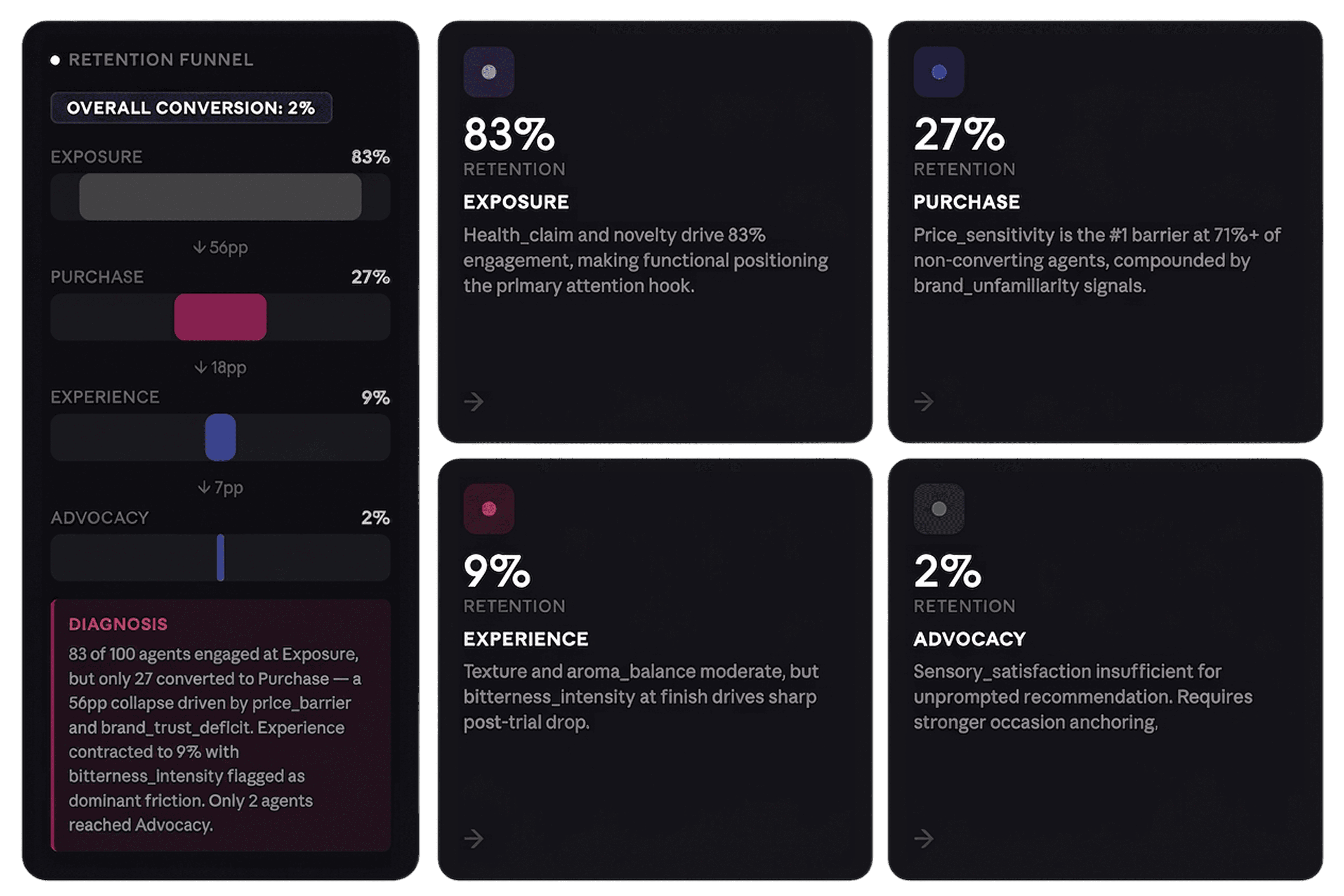
Aggregate results without losing the individual signal. The simulation summary layers responses across archetypes, taste types, demographics, and funnel stages in one unified view, so you can see simultaneously how an Optimizer responds versus an Enthusiast, how price sensitivity differs across age groups, and where your product wins or loses at each consumer moment. Filter by persona, segment, or funnel stage to isolate the insights that matter most for your specific brief. Strategic synthesis highlights the priority moves, not just the data.
Capacities
Consumer acceptance funnel: See exactly where your product loses people. From first impression through to advocacy, the funnel view shows which stage is underperforming and which consumer segments are dropping off first, giving your GTM strategy a precise diagnosis rather than a general score.
128 persona breakdown: Across 16 taste types and 8 foodie personalities, see exactly who loves the product, who rejects it, and why. Surfaces the reasons traditional research misses: the Pragmatist who wants it but resists the price, the Connoisseur who appreciates the formulation but rejects the claim.
Priority actions: go, no-go, go with conditions. Every simulation closes with a decision-ready verdict. Go with conditions means specific ranked actions, reformulate the finish, reframe the claim, adjust the price anchor, that move the product from borderline to launchable.
05
Friction of Cost
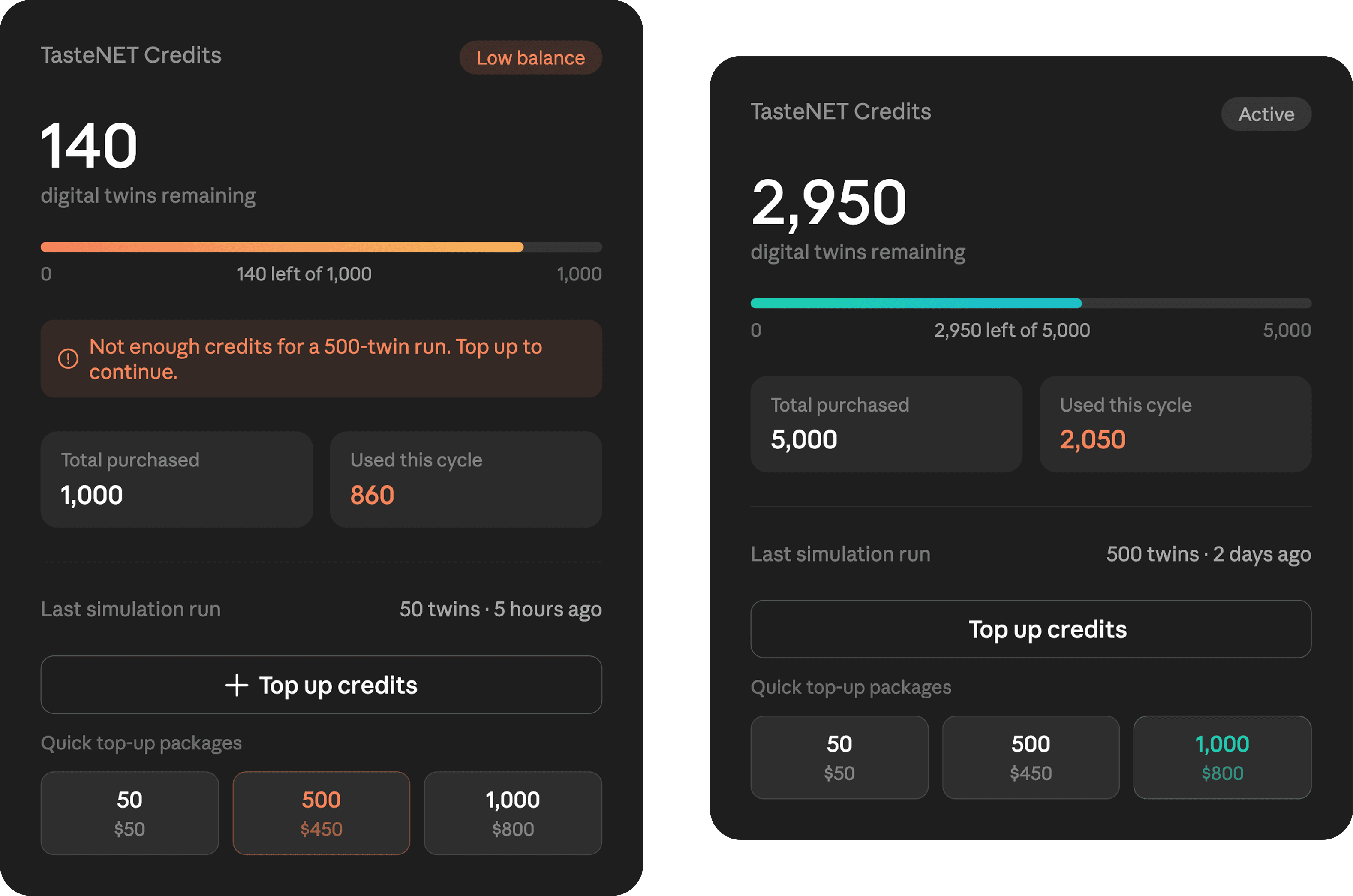
The same logic runs through how you pay and how you deploy. Pricing scales with the question. A few dollars to chat with a single twin during early exploration, far more to simulate a full launch across a thousand, and you only reach the larger numbers when the decision earns them. Deployment scales with the organization. Start on the cloud, live in days and billed by use, then move to private deployment when proprietary formulas, dedicated compute, or a group-wide rollout make it worth owning the stack. One product, two dials, and you set both.
Our Client-centric Principle
Plans start at $1,495 a month. Top up with credit packs as you go, and pay only for the depth each decision needs.
You only pay for the twins a run uses, so the same budget that buys one study elsewhere screens a whole pipeline here.
Start on the shared cloud, then move to private deployment when proprietary formulas or a group-wide rollout call for it.
06
Customisable In/Outputs


Every brand speaks a different language. TasteNET allows you to define your own product input fields, from proprietary formulation specs and internal sensory descriptors to custom target segments and regional variables. On the output side, shape the reporting format to match your KPIs, brand templates, and internal decision workflows. Whether you need a one-page executive summary or a full diagnostic breakdown by persona, the simulation output adapts to how your team actually works, not the other way around.
Use cases
Custimizable inputs: Define product inputs using your own formulation language, sensory descriptors, and category-specific variables. Whether you are briefing a functional beverage, a fermented snack, or a premium spirits line, the simulation speaks your product's language from the start.
Cusmizable outputs: Configure reporting to match your stage-gate templates, brand scorecards, and decision workflows. A one-page executive summary or a full persona-level diagnostic breakdown. The output fits how your team actually reviews and acts on insights.
One-time custom model setup, then pay only for what you run: We implement your customised simulation model once. After that, there are no subscription fees and no platform costs between runs. You pay only when you simulate.